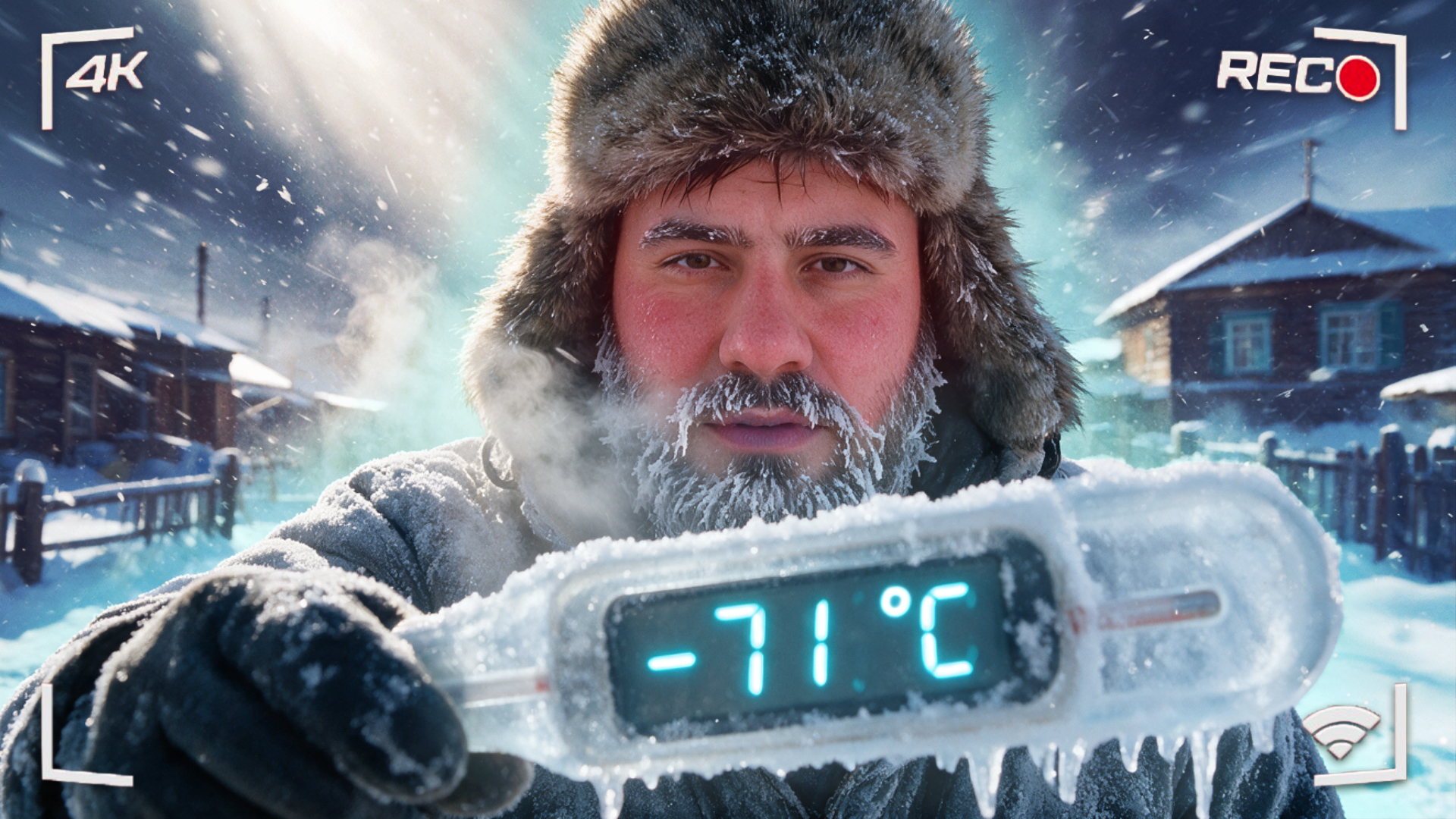
La Rinconada: Earth's Most Terrifying Secret City

Documentary Overview & Investigation Notes
Detailed Research Dossier
Imagine a city where your blood turns as thick as motor oil just to keep you alive, where there is no sewage, no trash collection, and no police—and where you work an entire month for free, gambling your life on a single day. This is La Rinconada, Peru. Perched over 5,100 meters high in the frozen Andes, it is the highest permanent settlement on Earth, sitting at the absolute biological limit of human survival. I'm Kayra, and let's get into the story of a frozen world that by all laws of nature simply shouldn't exist.
To understand why this place is terrifying, you have to understand the air. At 5,100 meters, atmospheric pressure is cut nearly in half. With every breath, your lungs receive roughly 50 percent less oxygen pressure than at sea level. Unacclimatized visitors risk lethal edema within hours. Yet roughly 50,000 people live here, packed into tin shacks clinging to frozen mud on Mount Ananea.
Why would anyone endure this? The answer is buried inside the mountain: gold.
And that brings us to how people survive here, through one of the most brutal labor lotteries on Earth: the cachorreo system. Miners don't earn a salary. There are no contracts, benefits, or safety gear. Instead, a miner works underground for up to thirty straight days for free—drilling rock, hauling rubble, and handling explosives for the mine contractor. Then, on day thirty-one, comes the payout: a single frantic shift called the carnaval. For twenty-four hours, the miner can enter the shaft and keep whatever gold-bearing ore he can physically carry out on his back.
Think about what that takes. At an altitude where walking uphill pushes your heart rate to 170 beats a minute, miners load woven sacks weighing up to 70 kilograms—over 150 pounds—onto their shoulders. They climb slick, freezing ladders out of pitch-black tunnels. But here is the cruelest catch: it's a pure gamble. If the rock you hauled turns out to be barren quartz or pyrite, you make zero dollars. You just gave thirty days of bone-breaking labor for nothing, leaving you deep in debt for the food and dynamite you bought on credit.
You'd think miners could turn to authorities, but the town operates in total abandonment. There is no sewage system. Waste from tens of thousands of residents drops into cliffside outhouses or onto the open scree. In freezing temperatures, waste freezes at night, thaws under the sun, and flushes straight into the proglacial lake below. Decades of uncollected garbage have frozen into the moraine, creating literal "trash glaciers" meters deep. And with no police, the community enforces its own brutal order. If a thief is caught stealing gold, mobs don't call the law. They strip the suspect naked in subzero cold, whip them publicly, and in documented cases, douse them in gasoline and burn them alive.
Yet as brutal as life is on the surface, here's where it gets even darker.
Under an ancient Andean superstition, women are strictly forbidden from entering the mines. Miners believe the mountain—Pachamama—is a jealous woman who will hide the gold and trigger fatal cave-ins if another female steps inside. So while men go underground, thousands of women known as pallaqueras—mostly single mothers and widows of miners killed in collapses—spend twelve hours a day on the freezing scree. In temperatures dropping to minus ten degrees, armed with four-pound sledgehammers, they smash thousands of discarded rocks by hand, searching for specks of gold, often with infant children strapped to their backs.
And when gold is found, an invisible poison takes over: mercury. Miners mix crushed rock with liquid mercury, squeezing the amalgam with bare hands into a small metallic button. To separate the gold, they don't use safety retorts. They roast the button with a blowtorch inside cramped tin shacks or open storefronts. The mercury boils, releasing toxic vapor that families inhale directly. That vapor crosses the blood-brain barrier, lodging in brain tissue and triggering tremors, memory loss, and psychiatric collapse.
When medical researchers from Expedition 5300 arrived, what they found stunned modern science. To cope with the lack of oxygen, the body mass-produces red blood cells. In La Rinconada, 44 percent of residents have excessive red blood cells, driving blood viscosity over 27 millipascal-seconds—four times thicker than normal. When doctors drew blood, it was so dense and dark it repeatedly clogged their needles, flowing like warm motor oil. Their hearts are forced to pump thick sludge against dangerous pressures. At night, blood oxygen drops to a median of 79 percent, causing miners to stop breathing in their sleep, waking up gasping in the dark.
Most miners here don't survive past their forties. Their lungs are destroyed by silica dust, their minds poisoned by mercury, and their hearts enlarged from pumping sludge. And the ultimate irony is where that gold goes: laundered through front companies and smuggled across borders, it ends up in luxury jewelry and central bank vaults across the globe.
La Rinconada stands as a haunting testament to the terrifying limits of human endurance, and the unfathomable price people will pay for the dream of striking gold.
Thank you so much for watching. If this journey into the highest town on Earth fascinated you, please drop a comment below, hit that like button, and subscribe for more deep dives into our planet's most extreme realities. I'm Kayra, and I'll see you in the next one.
Academic Bibliography & Museum Archive Sources
The following primary texts, archaeological surveys, and peer-reviewed papers back the claims in this documentary:
- ================================================================================
- BIBLIOGRAPHIC REGISTRY & SOURCE VERIFICATION DOSSIER: LA RINCONADA
- ================================================================================
- DOCUMENTARY RESEARCH REPOSITORY
- FORMAT PER ENTRY:
- [Number]. Title of source — Author (if known) — Publication/Institution — Year (if known) — URL
- (Where links are paywalled, offline, or unverified, marked as '(no link available)'
- in strict adherence to Non-Negotiable Rule 7: Link Integrity).
- ================================================================================
- SCIENTIFIC & MEDICAL STUDIES (ALTITUDE PHYSIOLOGY, MERCURY TOXICOLOGY)
- [1]. Highest Permanent Human Habitation — John B. West — High Altitude Medicine & Biology — 2002 — https://pubmed.ncbi.nlm.nih.gov/12631426/
- [2]. Expedition 5300: limits of human adaptations in the highest city in the world — B. Champigneulle, J.V. Brugniaux, E. Stauffer, S. Doutreleau, M. Furian, E. Perger, A. Pina, S. Baillieul, B. Deschamps, I. Hancco, P. Connes, P. Robach, A. Pichon, S. Vergès — The Journal of Physiology — 2024 — https://pubmed.ncbi.nlm.nih.gov/37707399/
- [3]. Excessive Erythrocytosis and Chronic Mountain Sickness in Dwellers of the Highest City in the World — I. Hancco, S. Bailly, S. Baillieul, S. Doutreleau, M. Germain, J.L. Pépin, S. Vergès — Frontiers in Physiology — 2020 — https://www.frontiersin.org/journals/physiology/articles/10.3389/fphys.2020.00773/full
- [4]. Blood viscosity and its determinants in the highest city in the world — E. Stauffer, E. Loyrion, I. Hancco, X. Waltz, M. Ulliel-Roche, L. Oberholzer, P. Robach, A. Pichon, J.V. Brugniaux, P. Bouzat, S. Doutreleau, P. Connes, S. Vergès — The Journal of Physiology — 2020 — https://pubmed.ncbi.nlm.nih.gov/32306399/
- [5]. Nocturnal hypoxemia, blood pressure, vascular status and chronic mountain sickness in the highest city in the world — E. Perger, S. Baillieul, F. Esteve, A. Pichon, G. Bilo, D. Soranna, S. Doutreleau, Y. Savina, M. Ulliel-Roche, J.V. Brugniaux, E. Stauffer, L. Oberholzer, C. Howe, I. Hancco, C. Lombardi, R. Tamisier, J.L. Pepin, S. Vergès, G. Parati — Annals of Medicine — 2022 — https://pubmed.ncbi.nlm.nih.gov/35748897/
- [6]. Micro- and macrovascular function in the highest city in the world: a cross sectional study — Y. Savina, A.P. Pichon, L. Lemaire, C.A. Howe, M. Ulliel-Roche, S. Skinner, E. Nader, N. Guillot, É. Stauffer, M. Roustit, I. Hancco, P. Robach, F. Esteve, V. Pialoux, E. Perger, G. Parati, P.N. Ainslie, S. Doutreleau, P. Connes, S. Vergès, J.V. Brugniaux — The Lancet Regional Health - Americas — 2024 — https://linkinghub.elsevier.com/retrieve/pii/S2667193X2400214X
- [7]. Cerebral blood flow in Andean children and adolescents living above 5,000 m — C.A. Howe, S. Vergès, D. Nowak-Flück, J.S. Talbot, B. Champigneulle, E. Stauffer, J.V. Brugniaux, S. Doutreleau, I. Hancco, S. Niroula, A. Pichon, A.M. McManus, M. Stembridge, P.N. Ainslie — Journal of Neurophysiology — 2025 — https://pubmed.ncbi.nlm.nih.gov/39719325/
- [8]. Higher Prevalence of Cognitive Impairment in Residents of High-Altitude Regions — M.E. Bernedo-Itusaca, J.M. Merma-Valero, T.M. Cruz-Riquelme, R.M. Ccorimanya-Suni, M.E. Pancaya-Flores, Z.M. Guevara-Mamani, D. Chambi-Rodrigo, M.A. Coa-Coila, W. Apaza-Cansaya, M.M. Apaza-Quispe, D.E. Hancco-Monrroy, C.A.L. Coila, A. Salazar-Granara, M. Yang, G. Viscor, I. Hancco Zirena — Oxygen — 2026 — (no link available)
- [9]. High Altitude Headache in Highlanders: A Hallmark Symptom of Chronic Mountain Sickness Related to Excessive Erythrocytosis? A Preliminary Report from the World's Highest City — I. Hancco Zirena, A. Florez Prada, D.E. Rojas Bolivar, A. Marengo, Y. Micha, S. Doutreleau, J.V. Brugniaux, S. Vergès, B. Champigneulle — High Altitude Medicine & Biology — 2026 — (no link available)
- [10]. La Enfermedad de los Andes: Síndromes Éritrémicos — Carlos Monge Medrano — Anales de la Facultad de Medicina de Lima — 1928 — (no link available)
- [11]. Monge's disease at 100 years: Revisiting the origins and endocrine mechanisms of chronic mountain sickness — Gustavo F. Gonzales — Science Progress — 2025 — (no link available)
- [12]. Consensus Statement on Chronic and Subacute High Altitude Diseases — Fabiola León-Velarde, M. Maggiorini, J.T. Reeves, M. Aldashev, I. Asmus, L. Bernardi, L. Ge, A.X. Hackett, T. Kobayashi, C. Monge, P.A. Robbins, T. Severinghaus, M. Schoene, R.B. Schoene, M. Vasquez, H.N. Ward, J.B. West — High Altitude Medicine & Biology — 2005 — (no link available)
- [13]. The city that should not exist / Hypoxia city — Martin Enserink — Science — 2019 — https://pubmed.ncbi.nlm.nih.gov/31515381/
- [36]. Mercury and Health: Artisanal and Small-Scale Gold Mining Assessment — World Health Organization (WHO) — World Health Organization Factsheet — 2017 — (no link available)
- [37]. High Altitude Medicine and Physiology (4th/5th Editions) — Michael P. Ward, James S. Milledge, John B. West — Hodder Arnold / CRC Press — 2010 — (no link available)
- [38]. Occupational and Environmental Exposure to Mercury in Artisanal Gold Mining Communities: A Global Review — D. Ceballos et al. — Journal of Toxicology and Environmental Health — 2014 — (no link available)
- [41]. Cerebral oxygen delivery and cognition at high altitude — J.S. Thomas et al. — Neuropsychology Review — 2000 — (no link available)
- [42]. High altitude, pregnancy, and infant health: Reproductive fitness in highland populations — Colleen G. Julian — American Journal of Physical Anthropology — 2011 — (no link available)
- ENVIRONMENTAL & GLACIOLOGY STUDIES
- [14]. Mercurio en un arroyo altoandino con alto impacto por minería aurífera artesanal (La Rinconada, Puno, Perú) — Alfredo Loza-Del Carpio, Yenny Ccancapa Salcedo — Revista Internacional de Contaminación Ambiental — 2020 — (no link available)
- [15]. Mercury concentrations of fish, river water, and sediment in the Río Ramis-Lake Titicaca watershed, Peru — Christopher H. Gammons, Darell G. Slotton, Butch Gerbrandt, Willis Weight, Courtney Young, R.L. McNearny, Eugenio Cámac, Ruben Calderón, Henri Tapia — The Science of the Total Environment — 2006 — https://linkinghub.elsevier.com/retrieve/pii/S004896970500714X
- [16]. Evolución de la cobertura glaciar del nevado Ananea entre 1985-2010 — Brandon Hernan Cuadros Amanqui — Universidad Andina Néstor Cáceres Velásquez (Tesis de Grado) — 2016 — (no link available)
- INVESTIGATIVE JOURNALISM
- [17]. Tears of the Sun: The gold rush at the top of the world — William Finnegan — The New Yorker — 2015 — https://www.newyorker.com/magazine/2015/04/20/tears-of-the-sun
- [18]. The Real Price of Gold — Brook Larmer (Photography by Fernando Moleres) — National Geographic Magazine — 2009 — https://www.nationalgeographic.com/magazine/article/gold
- [19]. Reportaje Especial: La Bella Durmiente: cómo el oro de origen sospechoso llegó a refinadores de Suiza y EEUU — Mitra Taj, Tito Contreras, et al. — Reuters — 2020 — (no link available)
- [20]. Gold, garbage and guns in the highest town on Earth — Deutsche Welle (DW) — DW News / Reportage — 2018 — https://www.dw.com/en/gold-garbage-and-guns-in-the-highest-town-on-earth/a-45886249
- [21]. Pallaqueras: las buscadoras de oro en el techo del mundo — Planeta Futuro — El País — 2017 — https://elpais.com/elpais/2017/09/06/planeta_futuro/1504706117_915831.html
- [22]. La Rinconada, 'la ciudad sin ley del Perú': conocida por su elevado nivel de violencia y por ser la mina más alta del mundo — Jazmine Angulo — Infobae Perú — 2023 — https://www.infobae.com/peru/2023/11/02/la-ciudad-sin-ley-conocida-por-tener-la-mina-mas-alta-del-mundo-y-un-alto-nivel-de-violencia/
- [23]. Doble crimen en La Rinconada: cuerpos de hombres fueron hallados en descampado de desechos — Clara Giraldo — Infobae Perú — 2025 — https://www.infobae.com/peru/2025/01/21/doble-crimen-en-la-rinconada-cuerpos-de-hombres-fueron-hallados-en-descampado-de-desechos/
- [24]. Inside Peru's lawless, toxic gold mines — Dan Collyns — The Daily Telegraph — 2020 — (no link available)
- [39]. Los patrones del oro: Las rutas del lavado de activos de la minería ilegal en el sur andino — Óscar Castilla — OjoPúblico — 2019 — https://ojo-publico.com/
- NGO & HUMAN RIGHTS REPORTS
- [25]. The Nexus of Illegal Gold Mining and Human Trafficking in Global Supply Chains: Lessons from Latin America (Peru Country Profile) — Verité — Verité / U.S. Department of State — 2016 — (no link available)
- [26]. Minería artesanal e informal en Puno: Estudio socioeconómico y ambiental en La Rinconada y Lunar de Oro — CooperAcción: Acción Solidaria para el Desarrollo — CooperAcción — 2018 — https://cooperaccion.org.pe/
- [33]. Informe de Adjuntía sobre Conflictos Socioambientales y Trata de Personas en Zonas de Minería Informal: Caso La Rinconada y Ananea — Defensoría del Pueblo del Perú — Defensoría del Pueblo — 2021 — (no link available)
- GOVERNMENT & STATISTICAL SOURCES (PERU: INEI, MINEM, MINAM, MUNICIPAL/DISTRICT)
- [28]. Censos Nacionales 2007: XI de Población y VI de Vivienda — Resultados Definitivos Departamento de Puno / Distrito de Ananea — Instituto Nacional de Estadística e Informática (INEI) — 2008 — (no link available)
- [29]. Censos Nacionales 2017: XII de Población, VII de Vivienda y III de Comunidades Indígenas — Perfil Sociodemográfico de Puno y Distrito de Ananea — Instituto Nacional de Estadística e Informática (INEI) — 2018 — (no link available)
- [30]. Censos Nacionales 1981: VIII de Población y III de Vivienda — Tomo Puno — Instituto Nacional de Estadística e Informática (INEI) — 1982 — (no link available)
- [31]. Registro Integral de Formalización Minera (REINFO): Base de datos nacional y regional Puno — Ministerio de Energía y Minas del Perú (MINEM) — MINEM / Dirección General de Formalización Minera — 2023 — (no link available)
- [32]. Plan de Acción Multisectorial para la Implementación del Convenio de Minamata sobre el Mercurio en el Perú — Ministerio del Ambiente del Perú (MINAM) — MINAM — 2019 — (no link available)
- PRIOR DOCUMENTARIES & PHOTO ESSAYS
- [34]. Toughest Place to be a Miner (featuring Paul Ballantyne in La Rinconada) — BBC Two / Director: Lucy Carter — British Broadcasting Corporation (BBC) — 2011 — (no link available)
- [35]. Peru's highest town struggles with poverty, pollution and pandemic — Al Jazeera English — Al Jazeera Media Network — 2021 — (no link available)
- ACADEMIC/ANTHROPOLOGICAL SOURCES
- [27]. Formalización de la minería artesanal en la rinconada y su impacto en la economía regional, Puno - Perú — Roberto Chávez Flores, Jhonatan Hinojosa Mamani, Javier Elías Mamani Gamarra, Robert Orlando Medina Lima, Victor Cipriano Flores Flores — Ciencia Latina Revista Científica Multidisciplinar — 2023 — https://ciencialatina.org/index.php/cienciala/article/view/7076
- [40]. Miners' endurance in informal gold mining: the extreme case of La Rinconada, Peru — Eugenia Robles Mengoa, Ana Luisa Sánchez — Research Papers in Economics (RePEc) / Working Papers Series — 2024 — (no link available)